October 5, 2026 · 6 min
Collapsed sewer line repair cost: the one defect lining cannot fix, and what decides the dig
A collapse is the defect this site says lining cannot touch. What decides the cost is depth, surface, the length of the dig and whether the building has to keep draining while it happens. No figure here, for a reason.
What does a collapsed sewer line cost to repair? It is the one cost question on this site with a partly simple answer: whatever the repair costs, it will not be a liner. A collapse is a pipe that has lost its bore, and a liner needs a bore to be installed through. That much is settled before anyone measures anything. What is not settled is what the dig costs, and the honest version of that answer is a list of factors rather than a number. No figure appears here, for the reason given on why published repair ranges mislead. If sewage is backing up as you read this, start with the emergency article.
What a collapse is, and what gets called one
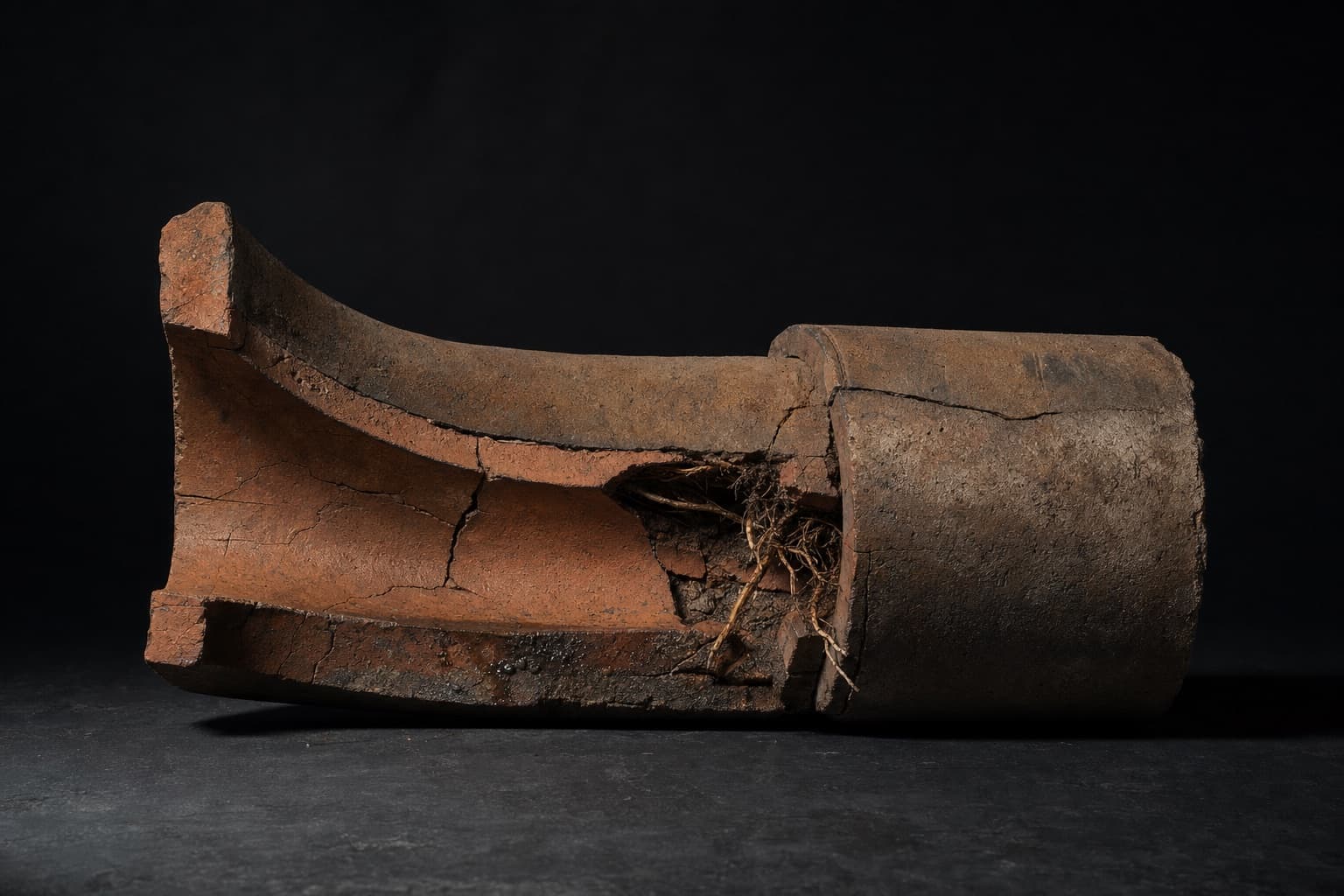
A collapse is a section where the pipe wall has broken and fallen in, so that soil, fragments or a crushed profile fill the bore. It is not a heavy root mass, which a jetter can cut. It is not a deformed pipe that has ovalled but still has a passage. It is not a blockage backing water up from further down. All three get called a collapse over the phone, and all three are lining candidates or clearing jobs.
How a collapse is confirmed on camera
The camera travels the line and stops. What matters is what the lens sees at the stop: soil or gravel where the pipe wall should be, broken fragments, or a wall of debris that jetting from the other side cannot move. A locator over the camera head then fixes the two measurements the dig will be built on: the distance from the access point and the depth at that point. Where a second access exists, the camera goes in from the far side to find the other end of the collapse, which gives its length. What the camera can and cannot establish is on what a camera survey finds.
Why lining cannot fix it
A cured-in-place liner is inverted or pulled through the host pipe and pressed against its wall. It needs a continuous passage to travel and a wall to take shape against. A collapse offers neither. Pipe bursting sometimes remains possible where a cable can be passed through the collapsed section, but frequently it cannot, and the head has nothing to follow. So a true collapse is excavated, and the honest question becomes how much excavation. The comparison between the methods is on lining versus replacement.
What decides the cost: depth
Depth decides the trench. A shallow lateral under a lawn is a small hole with hand tools. A deep line needs a wider trench or shoring, an excavator, spoil handling and, past a certain depth, engineered protection for the people in it. The depth reading from the locator is therefore the first cost driver on the page. The figures published for full replacement, and who published them, are collected on sewer line replacement cost.
What decides the cost: the surface
What is on top of the collapse comes off and goes back. Grass is forgiving. A driveway, a public sidewalk, a road, a slab floor or a foundation each add cutting, reinstatement and, where the surface is public, whatever the jurisdiction would require in permits and traffic control. Reinstatement is routinely the largest single line on a collapse repair, and it is also the line most often left out of a quote as an exclusion. Ask.
What decides the cost: the length of the dig, and the bypass
A collapse is usually short. Whether the dig is short depends on the rest of the pipe. If the camera shows the line either side to be sound, the dig is a spot repair over the collapse and the pipe goes back together with couplings. If the line either side is failing in the same way, the collapse is the first section to go rather than the only one, and the honest scope is a dig over the collapse plus a liner through the rest, or a longer replacement. That decision is made on the footage. And if the building is a business or a block of apartments, bypass pumping keeps it draining while the section is dug, and that equipment is its own line on the scope. The variables that drive the excavation itself are set out on the replacement cost article.
The sequence
Confirm the collapse on camera, with distance, depth and length. Survey the rest of the line while the camera is in. Decide the scope of the dig from the footage. Then quote, with reinstatement, bypass and permits included or listed as exclusions. Any number offered before that sequence is a guess about a hole nobody has seen the bottom of.
Confirm it is a collapse before anyone digs
A camera pass with distance and depth is what a dig is planned on. Insist the recording is yours, whoever excavates.
CIPP Connect is an independent reference on buying pipe rehabilitation. It lines no pipe and holds no contractor licence. It explains what a survey has to show, which defects rule lining out, what a scope must specify, and what verification to demand on work you will never see with your own eyes.