Inspection and assessment: nobody can quote a liner from a description
No specialist can price a liner from a description of the symptoms, and none should try. What they need is a survey, and what you need is to know what a good one contains, because the report you accept here determines every decision downstream.
Why the survey comes first
A liner is designed, not selected from a shelf. Its wall thickness follows from the condition of the host pipe, its diameter, its depth, the loads above it and whether the existing pipe still carries any of them. Every one of those inputs is a finding.
That is why a quote produced over the phone from a symptom, “it backs up every few months”, is not a quote. It is a placeholder that will be revised once somebody looks, and the revision will not be downward.
It also explains a sequencing detail that surprises people: the line usually has to be cleaned before it can be properly surveyed, and it is surveyed again after cleaning. Both runs matter, for different reasons, see the stage-by-stage walkthrough.
What a survey actually involves
Access and setup
The camera enters through a manhole, a cleanout or an opened fitting. Where no access exists, one is created, which is itself useful information about the eventual lining job.
The camera run
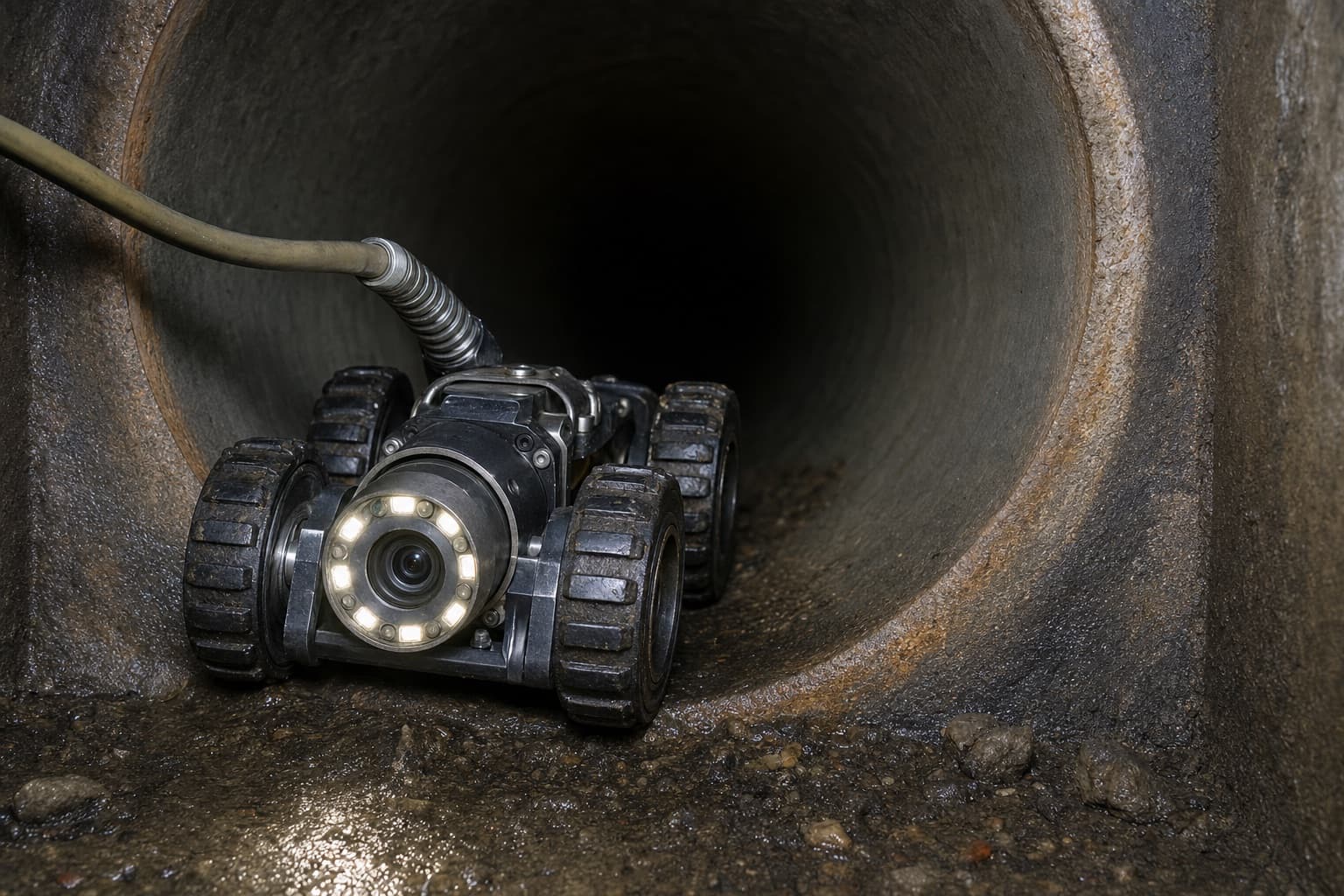
A self-propelled crawler in larger pipes, a push camera in small ones. What distinguishes a professional run from a quick look is method: constant speed, stopping at every defect, recording distances from a fixed datum, and panning at every connection rather than driving past it.
Coding and grading
Defects are recorded using a standardized coding system so that a third party reading the report reaches the same conclusion as the operator who filmed it. Structural defects and operational ones are separated, each with a severity grade and a position along the run.
Measurement
Length from datum, actual diameter, position of every lateral and every bend. On a lining project these numbers are not context, they are the shopping list.
Supporting tests, where relevant
Dye testing to establish where a connection actually goes, smoke testing to find unrecorded connections and defects on a wider network, flow monitoring where infiltration is suspected, and manhole condition assessment, since a sound pipe between two failing structures is only part of a solution.
How to read the report you are given
A useful report answers five questions without needing a conversation. If yours does not, ask for the missing ones before it is used to make a decision.
- Where does each defect sit, measured from a stated starting point?
- How severe is it, on a scale that is named rather than adjectival?
- Is it structural, the wall failing, or operational, such as a deposit or a root mass?
- Where are the laterals, the bends and the changes of material or diameter?
- What condition is the line in overall, expressed as a grade rather than as “it's in bad shape”?
Video alone is not a report. It is evidence, and it is worth having, but a two-hour file with no log and no distances cannot be compared with anything, cannot be sent to three bidders, and will not be read by any of them.
The traps worth knowing about
The free inspection attached to a sale
A no-cost camera run offered by a company that also sells the repair is not automatically dishonest, and plenty are done well. It is, however, an assessment produced by the party who benefits from the conclusion. On a project of any size, an independent survey, or at minimum a second opinion on the same footage, is cheap insurance.
The survey done before cleaning, and never repeated
Deposits hide defects. A report written from a dirty pipe understates the condition, and the correction arrives mid-project as a change order.
The conclusion that arrives before the evidence
“It all needs lining” said before the run is complete, or “a point repair will do” said without looking past the first defect, are both the same failure: a recommendation that did not come from the survey.
The missing sag
Standing water in the camera view is the single most consequential finding on a lining project, because it changes the answer entirely. It should be called out explicitly, with its position and extent, see lining or replacement.
What to ask for, in writing
- A coded condition report, not only video.
- Distances from a stated datum, and the direction of travel.
- A separate list of laterals with their positions.
- An explicit statement about grade: is there standing water, and where.
- The raw footage, retained and provided on request.
- Whether the operator holds a current certification in the coding standard used.
None of this is unusual, and none of it is expensive to specify in advance. All of it is difficult to obtain retroactively from a survey that has already been used to justify a quote.
Frequently asked
How much does a camera survey cost?
It varies with access, length, cleaning required and the depth of the reporting, and this site publishes no figures. What is worth knowing is that a coded report costs more than a quick look and is worth the difference on any project heading toward a rehabilitation decision.
Does the pipe have to be cleaned before the camera goes in?
For a survey that will be used to design a liner, effectively yes. A first run through a dirty line is useful for triage; the report that decisions rest on should come from a cleaned pipe.
Can I use one survey to get several bids?
That is exactly what it is for, and it is the only way bids become comparable. Ask for the report in a portable format and for permission to share it.
Last reviewed July 29, 2026.
Get the line assessed before anyone quotes it
Describe what you have, including “nothing yet”. Specialists can start with the survey and quote the work from findings rather than from guesses.
CIPP Connect rehabilitates pipe in place: camera inspection and assessment, cleaning, cured-in-place liner installation, lateral reinstatement and post-installation verification. One crew, one written scope.