August 1, 2026 · 7 min
What decides the cost of replacing a sewer line, and when lining is cheaper
The pipe is a small part of the number. What sits above it, and what has to be put back afterwards, is most of it.
This query is searched as often as the method itself and paid for more highly, which tells you what people are actually worried about. The useful answer is not a number, it is the list of things the number is made of.
1. Depth, which is exponential rather than linear
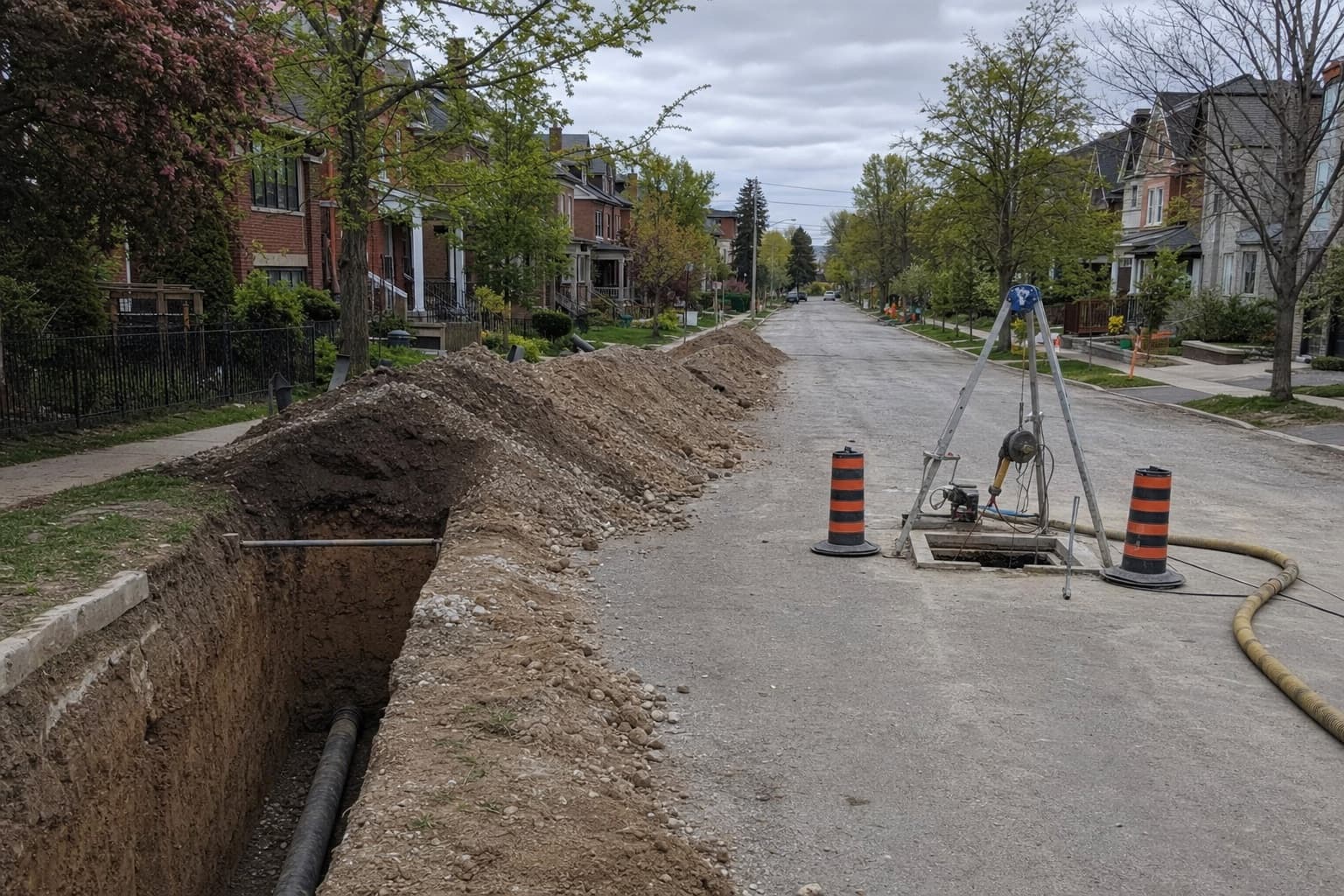
A pipe at three feet is a trench. A pipe at twelve feet is a trench with shoring, a much larger excavation footprint because of the sides, far more spoil to remove and replace, and a different set of safety requirements. Depth is the single biggest driver of an open excavation and the reason two lines of the same length can differ by a multiple. The deepest pipe on any property is the main, which is most of why a main costs more than a branch.
2. What is on top of it
Grass is cheap. A driveway is not. A mature tree, a retaining wall, a patio, a garage slab, a public road with a traffic management requirement, a railway crossing: each of these turns a length of trench into a separate project with its own permit and its own reinstatement bill.
This is where trenchless methods earn their money. The pipe costs roughly the same either way. Not removing and rebuilding the driveway is the saving, and which lines move when the method changes is worth reading line by line.
3. Reinstatement, which is frequently quoted separately
Backfilling to the correct compaction, restoring the surface to the standard the jurisdiction requires, replacing landscaping. Read a replacement quote carefully for what it says about surface restoration, because “restore to grade” and “replace the driveway” are different sentences with very different totals.
4. Access and staging
Whether a machine can reach the line at all. A back garden with no side access, an under-slab line inside an occupied building, a city street with no room for a truck: each changes the work from mechanical excavation to hand digging, or to a different method entirely.
5. Permits and inspection
Work on a sanitary connection is permitted and inspected in most jurisdictions, and work in the public right of way requires its own permit, sometimes with restrictions on hours and a bond. These are rarely the largest line and they are frequently the longest.
When digging is genuinely the cheaper answer
It is worth saying plainly, on a site that does the other thing:
- A short shallow run under grass, where the trench costs less than mobilising a lining crew.
- A collapsed section, where there is nothing left to line.
- A line with a belly, where the grade has to be corrected rather than followed.
- A pipe that has to be rerouted, resized or reconnected somewhere else.
- A small-diameter line where losing bore to a liner is not acceptable.
The full comparison is on lining versus replacement, and what makes up a lining quote specifically is on lining cost.
Why no figure appears on this page
Because the five items above vary by an order of magnitude between two houses on the same street, and any number published here would be wrong for nearly everyone who read it, in a direction that costs them money or wastes their time. The same objection applies to every online sewer cost calculator. What we can do is look, and then commit in writing.
Get both options priced from the same survey
We will tell you when digging is the better answer. It happens more often than the industry admits.
CIPP Connect rehabilitates pipe in place: camera inspection and assessment, cleaning, cured-in-place liner installation, lateral reinstatement and post-installation verification. One crew, one written scope.