August 8, 2026 · 6 min
Why there is no honest sewer line cost calculator
Three hundred and ninety people a month look for one. The ones they find are lead capture forms with arithmetic attached, and here is exactly why the arithmetic cannot work.
People search for a calculator because they have been given a frightening number and want to know whether it is reasonable. That is an entirely sensible thing to want. The problem is that the calculation has an input nobody has at the point of asking. The one figure that can be settled in advance is what the survey itself costs.
The missing input is what the pipe actually looks like inside
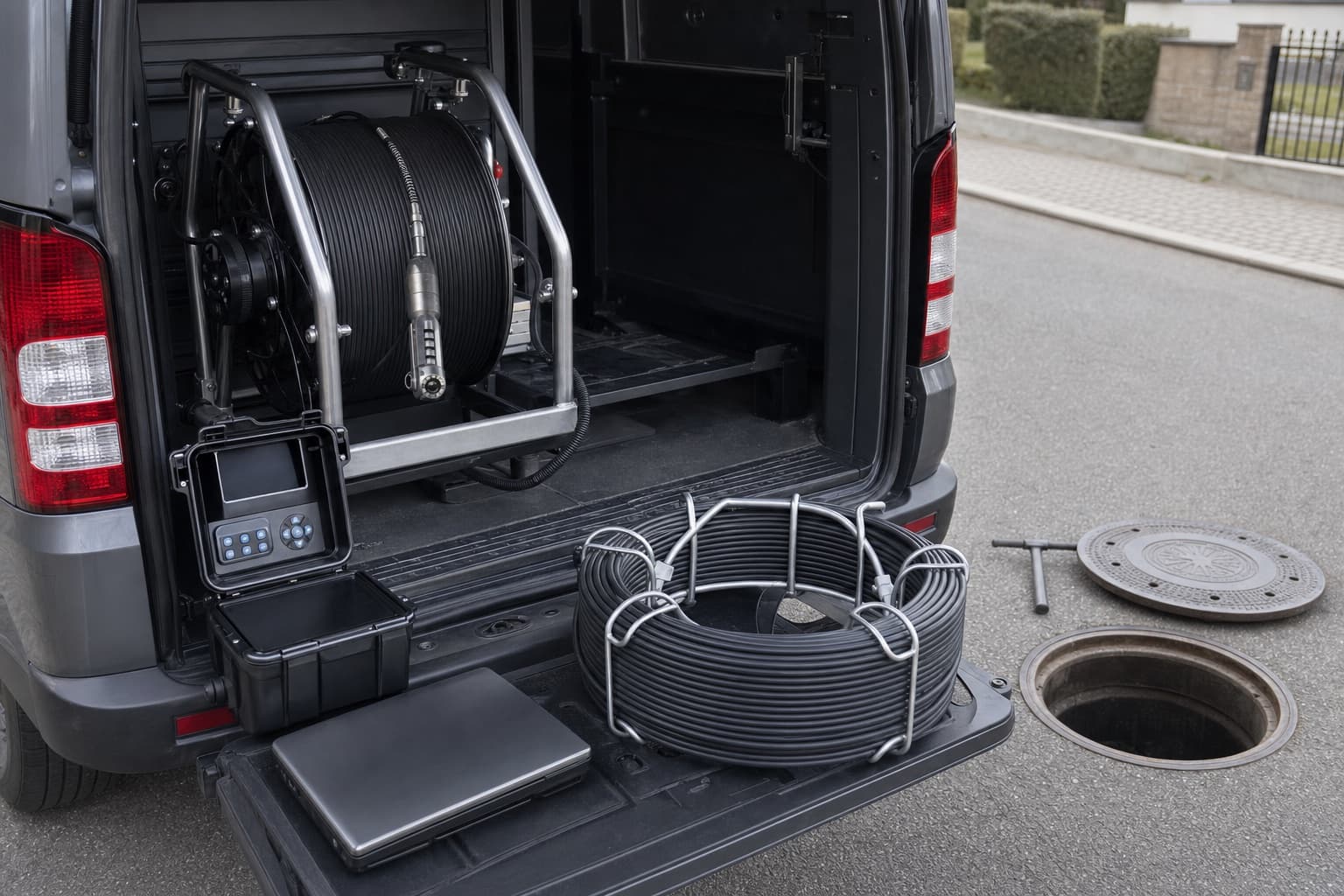
Every variable that decides the price, the depth, the material, the defect type, the number of laterals, whether there is a belly, whether a section has collapsed, is established by putting a camera down the line. Before that survey, the honest range spans more than an order of magnitude. What the camera does and does not settle is on what a camera survey finds.
A calculator that asks for length and house type is not estimating this job. It is reporting an average of other jobs, and it is doing it in order to collect a phone number.
What the published averages actually measure
Averages compiled from completed work are real numbers about real projects. They are also dominated by whichever kind of project is most common in the data set: shallow suburban laterals under grass, or deep urban lines under pavement, depending on where the data came from. Applied to your line, an average is a coin toss with a decimal point.
The four questions that would make an estimate meaningful
- How deep is the line, at the shallowest point and at the deepest?
- What is on top of it, for its whole length?
- How many lateral connections are on the run, and where?
- What does the camera show: roots, cracks, corrosion, a belly, a collapse?
Nobody can answer four from a web form, and three is frequently wrong from memory. Which is why the first thing we do is put a camera down it.
How to sanity-check a quote you already have
Not with a calculator. With these:
- Ask for the camera footage, and watch it. It is your pipe.
- Ask which defects justify the scope, and where they are, by distance.
- Ask what happens to the surface afterwards, in one sentence you could hold someone to.
- Ask what is excluded. This finds the reinstatement and the bypass.
- Ask for the same scope from a second contractor, using the same footage.
Five questions, no arithmetic, and they turn two incomparable numbers into two comparable ones. That is what a calculator was supposed to do for you, and the anatomy the questions are aimed at is the five lines a lining quote is made of.
What we publish instead of a number
The list of what a quote is made of, on lining cost, and the honest cases where digging wins on lining versus replacement. Neither will tell you what your job costs. Both will tell you whether the quote in your hand makes sense.
A survey costs less than a wrong estimate
We would rather look and commit than guess and revise.
CIPP Connect rehabilitates pipe in place: camera inspection and assessment, cleaning, cured-in-place liner installation, lateral reinstatement and post-installation verification. One crew, one written scope.