October 23, 2026 · 6 min
Sewer lateral inspection: what it covers, and what it cannot show
A camera run from the cleanout to the main is the only way to see a lateral without digging it up. Here is what a useful one records, and where its limits are.
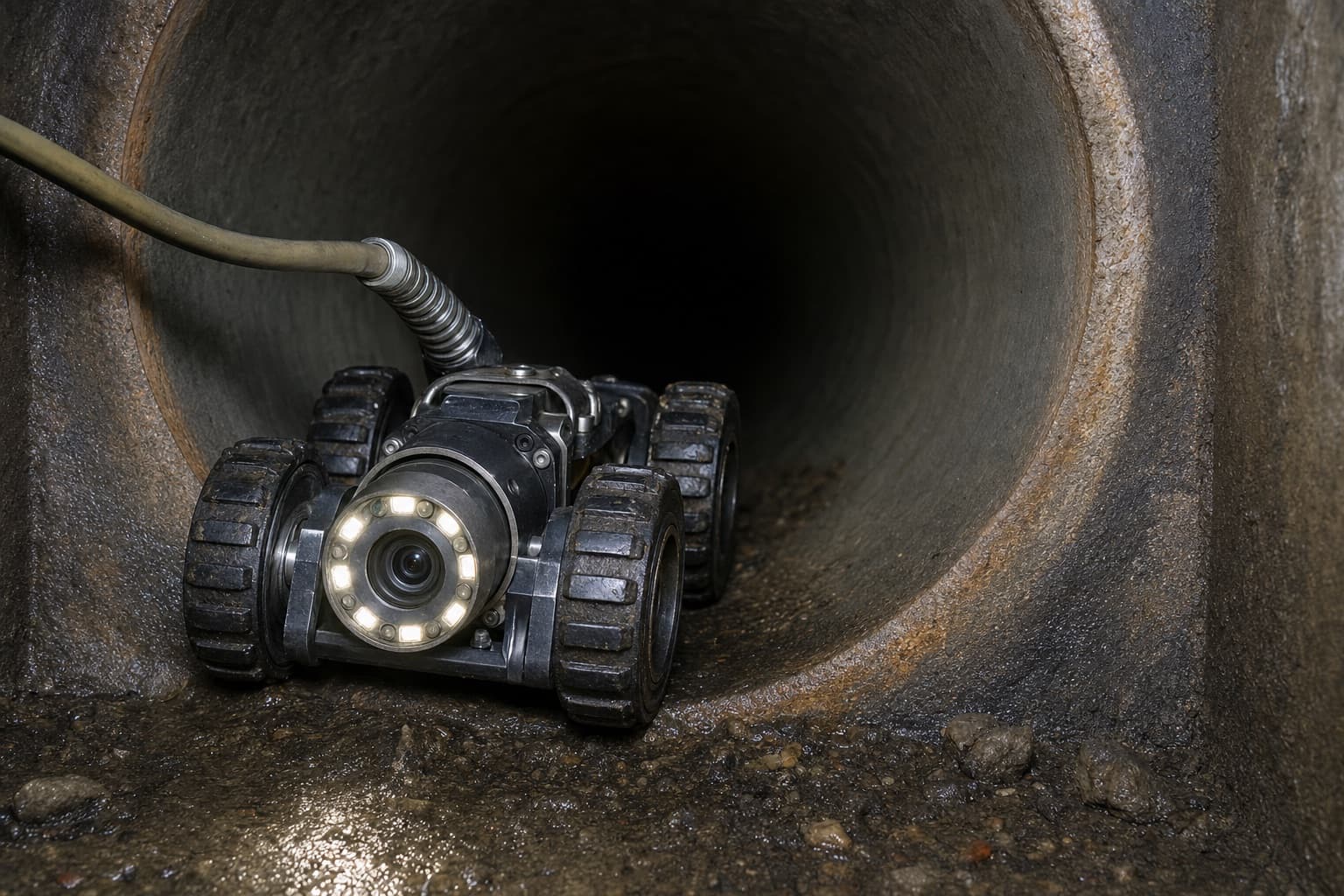
A sewer lateral inspection is a camera survey of the pipe between a building and the public sewer. A push camera on a rod goes in at a cleanout, or through a fixture when there is none, and travels toward the main while a counter records how far it has gone. What comes back is a recording, and the recording is the product.
When people ask for one
Before buying a house, when a drain keeps backing up, before a remodel that adds bathrooms, and in a number of cities and utility districts because a programme requires it at sale or at certain permits. Those programmes differ widely, in what they require and in what they accept as proof, so the first call is to the local utility rather than to a contractor.
A survey before purchase is the one most often skipped and most often regretted. A general home inspection does not look inside the lateral, and the seller is not usually obliged to have done so. The cost of a camera run is small next to the cost of finding a collapsed section in the first winter, and the recording is a negotiating document while the sale is still open.
What a useful recording shows
The whole length, cleanout to main, without cuts. A distance counter visible on screen the whole time. The pipe material and any change of material along the way. Every joint that is offset, open or infiltrated. Roots, with where they enter. Cracks, breaks and missing sections. Standing water that marks a sag. And the connection to the main, which is the part most often skipped because it is the hardest to reach.
What it cannot show
The outside of the pipe, the soil around it, and the depth, unless a locator is used at the same time to mark the camera head from the surface. A camera also struggles through a pipe that is full of water or debris, and a survey done through a blockage records the blockage, not the pipe. If the line has to be cleared first, the footage should be taken after clearing, and it should say so. More on what a camera finds is in the camera inspection article.
Inspection cost, and why we do not print one
Access decides most of it: whether there is a cleanout, how far the camera has to travel, whether the line has to be cleared first and whether a locator is needed. A figure printed here would be the wrong one for most readers, so there is none. What we can say is what a quote for a survey should name, and that is the same list as above.
Reading the report without being sold to
A survey report should describe defects by position and type, in words, alongside the footage. It should not arrive with a repair already chosen and priced on the same page as the findings. A defect can usually be dealt with in more than one way, and the method should be argued from the footage, not the other way round.
Ask for the file itself, not a link that expires or a few screenshots. Ask that defects be named in plain language with their distance from the access point, and that the report say where the survey started and where it stopped. If the camera could not reach the main, the report should say that too, because the last few feet before the connection are where several of the most expensive defects sit, and a survey that stops short of them has not looked at the whole pipe.
What we do with one
We survey laterals on their own terms, with the recording handed over as a file you keep, whoever ends up doing any repair. The scope of that work is on the sewer scope inspection page, and a request can be made from the project review form.
Get footage you can keep
A lateral inspection is worth what its recording is worth: distances, defects named, and a file that stays with you.
CIPP Connect is an independent reference on buying pipe rehabilitation. It lines no pipe and holds no contractor licence. It explains what a survey has to show, which defects rule lining out, what a scope must specify, and what verification to demand on work you will never see with your own eyes.