September 4, 2026 · 7 min
Sewer camera inspection: what the camera finds, and what it cannot
A camera survey is the only honest starting point for any sewer work. It is also routinely oversold, so here is what it genuinely shows and where it stops.
A sewer camera inspection sends a camera down the line and records what is there. It is the first stage of every job on this site, and it is the one piece of work we will not skip, because everything after it is guesswork otherwise. Six thousand six hundred searches a month look for it, which suggests plenty of people already understand that. What is less clear is what the survey actually proves, and what the appointment itself is priced on, which is access, length and the report you receive.
The two kinds of camera, and why it matters which one comes
A push camera is a semi rigid rod fed in by hand from a cleanout or a removed fixture. It suits laterals and short runs, and its reach is limited by the bends it can negotiate. A crawler is a tracked unit driven down a larger line, usually from a manhole, and it carries stronger lighting and a pan and tilt head. A push camera in a large main sees a small circle of a big pipe. Which tool arrives should follow from the pipe, not from what is on the van.
What the recording genuinely shows
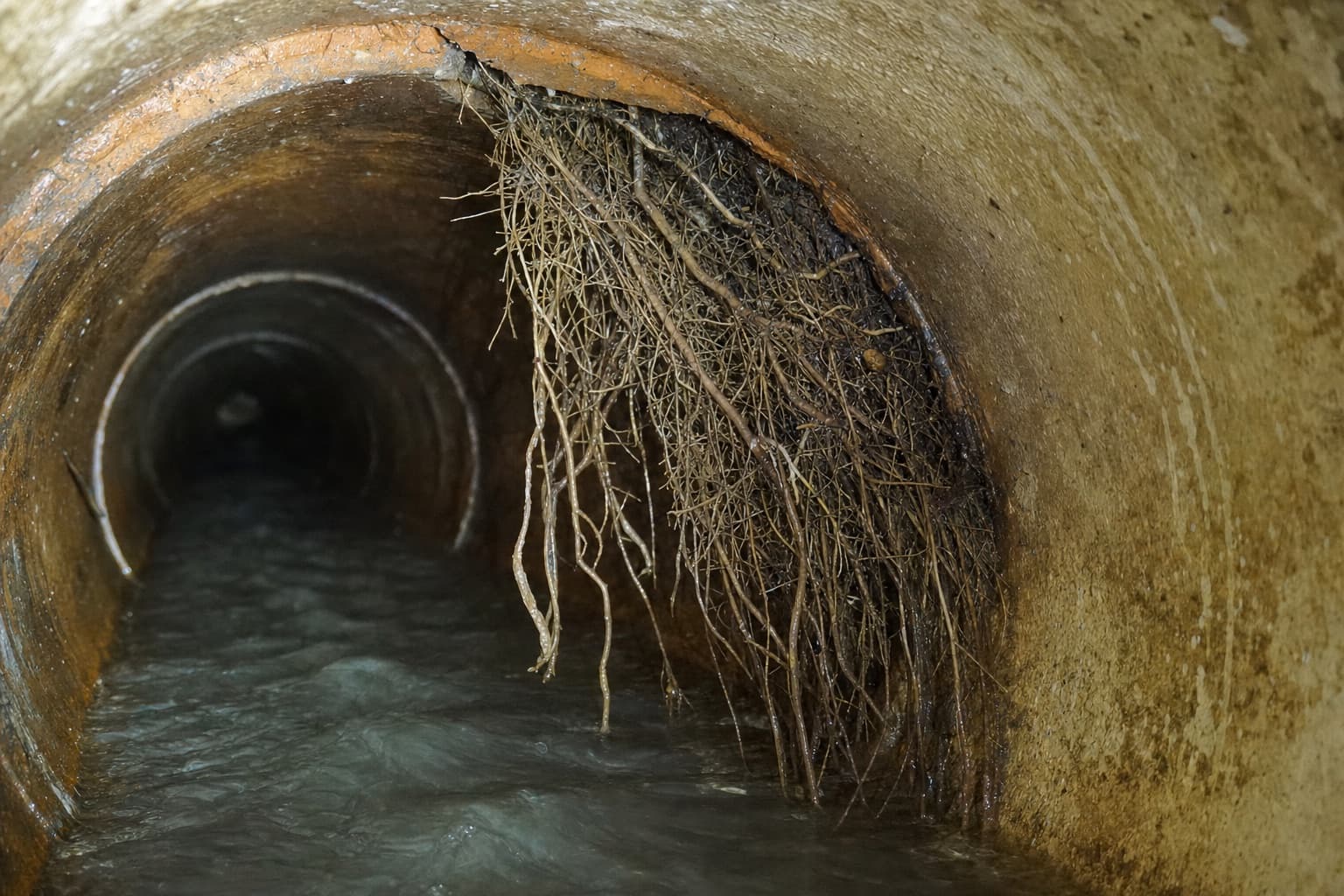
Material and diameter. Joint condition. Root intrusion, and whether it is a fine mass at one joint or a run of them. Cracks, fractures and the difference between the two. Offset joints where a section has moved. Bellies, where the line has sagged and holds water. Collapsed or deformed sections. And every lateral connection with its distance from the access point, which matters enormously later because a liner covers laterals until they are cut back open.
Distance and depth are the useful part
A survey without footage counts is an entertaining video. The number that makes it a survey is the distance to each defect from a known access point, logged as the camera travels, so that a defect can be found again from the surface. A locator sonde in the camera head lets that point be marked on the ground above, with a depth. That pair of numbers, position and depth, is what turns a picture of a crack into a repair that can be planned, chosen from the four trenchless methods. Insist on it.
What a camera cannot tell you
It cannot see through the pipe wall, so it cannot show a void behind a fracture, the condition of the bedding, or how much soil has been washed out around a leaking joint. It cannot measure wall thickness. It cannot tell you what a pipe will do in five years. And a line full of grease or standing water hides its own floor: a survey run through a dirty pipe is a survey of the grease. This is why cleaning comes first when the line allows it, and why a survey done before cleaning is sometimes worth repeating after.
Why the report matters more than the video
A recording alone puts the burden of interpretation on the person least equipped to carry it. What should arrive is the recording plus a written observation log: defect, type, severity, distance, and a recommendation with a reason attached. That document is what makes a second opinion possible, and it is what lets two quotes be compared against the same facts rather than against two different descriptions of the pipe. How we handle it is on the inspection and assessment page.
The conflict of interest worth naming
The firm holding the camera usually also sells the repair. That is normal, and we are in the same position. What keeps it honest is documentation you keep: a recording you can replay, a log you can read, and defects located precisely enough that anyone else could verify them. A survey that produces only a verbal conclusion and a same day price is not an inspection, it is a sales call with a camera on it.
What the survey decides next
Whether lining is possible at all, and over what length. Whether the line has to be dug instead, which happens more often than a lining company is usually keen to say. Whether cleaning alone resolves what the caller actually complained about. The comparison is set out on lining against replacement, and the survey is the only thing that settles it.
Start with the survey
Nothing about a repair can be quoted honestly before someone has looked inside. Ask us for the recording and the report, not a verbal summary.
CIPP Connect rehabilitates pipe in place: camera inspection and assessment, cleaning, cured-in-place liner installation, lateral reinstatement and post-installation verification. One crew, one written scope.