August 17, 2026 · 7 min
Trenchless sewer repair: the four methods, and how the pipe chooses between them
Lining, pipe bursting, a sectional patch, or a coating. They are not interchangeable, and the survey decides which of them is even in play before anyone does.
Trenchless sewer repair is a family of methods rather than a product. Cured-in-place lining, pipe bursting, sectional point repair and spray-applied coatings all avoid opening a trench along the line, and that is roughly where the resemblance ends. They repair different defects, need different things from the host pipe, and fail in different ways when chosen for the wrong reasons. What they share is a bill dominated by the access pits.
CIPP lining: a new pipe formed inside the old one
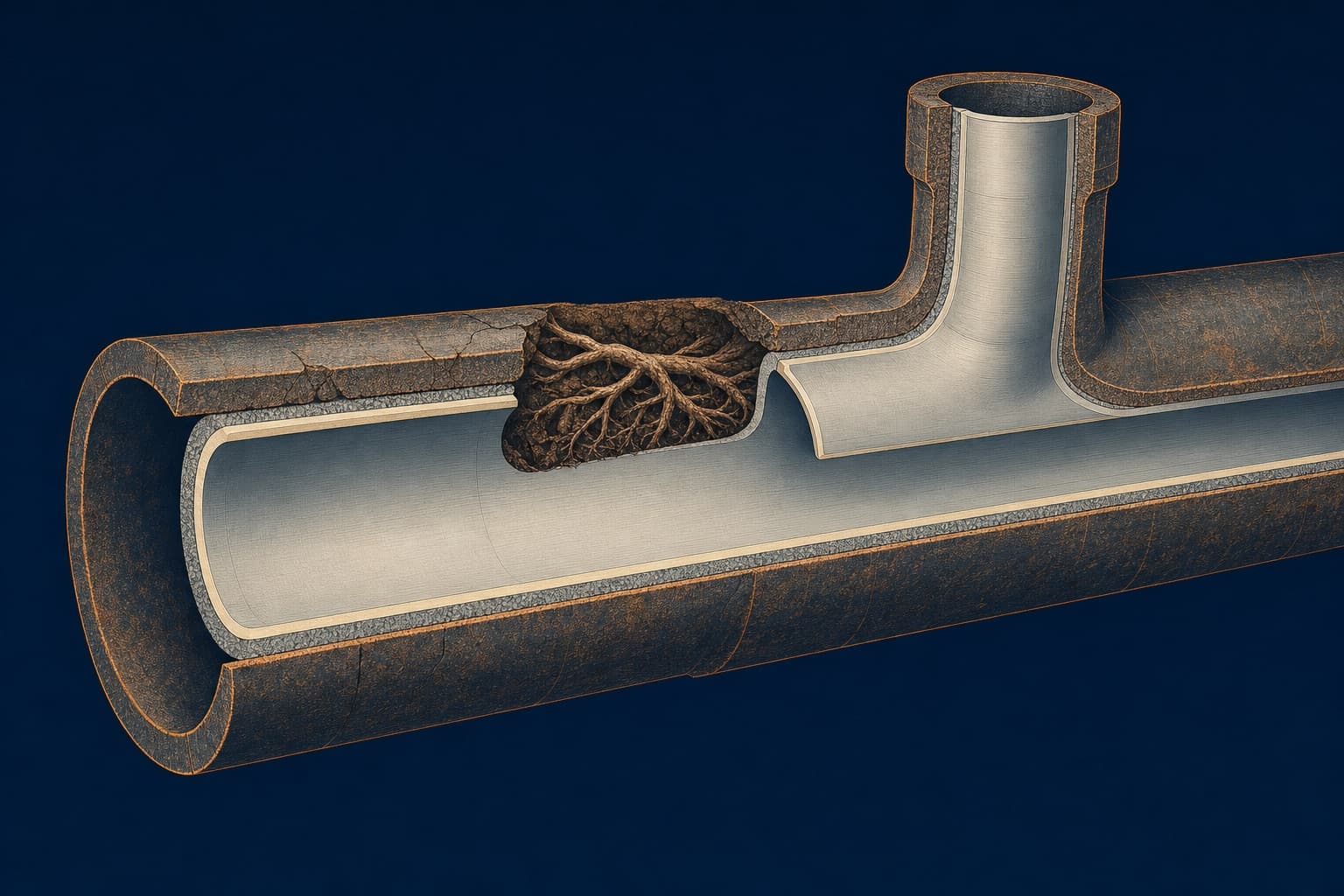
A resin-saturated tube is installed through an existing access point, inflated against the host wall and cured hard. The old pipe becomes a mould and stays where it is. Lining suits cracked, corroded and root-invaded pipe that still holds its shape, and it treats the whole run in one operation. The stages are on the lining page.
Pipe bursting: replacement without the trench
A bursting head is pulled through the old line, fracturing it outward into the surrounding ground while towing a new pipe into the space behind it. Unlike lining, the result is a genuinely new pipe, and the method can install the same diameter or a size up. It needs an entry pit and a receiving pit, a line the tooling can be pulled through, and ground and neighbouring services that can tolerate the displacement. How its bill differs from a trench is on what a trenchless replacement moves.
Sectional point repair: one defect, one short liner
A short liner placed over a single joint or crack rather than the whole run. On an otherwise sound pipe with one localised defect it is quick and proportionate. On a pipe with defects along its length it is a subscription, because the next failure appears beside the patch. Which of those describes your line is a reading of the footage, not a preference.
Spray-applied coatings, briefly
A polymer or cementitious layer sprayed onto the cleaned wall. Useful against corrosion and infiltration in larger structures, and dependent on surface preparation to a degree the finished video does not show. A coating is not a structural repair unless it is designed and applied as one.
What every method needs from the host pipe
All four assume there is still a pipe to work inside. A camera and, where shape matters, a measurement of ovality have to establish that before a method is named. A liner needs a bore it can pass and press against. Bursting needs a continuous path for the tooling. A patch needs sound pipe either side of the defect. None of that is visible from the surface, which is why the survey comes before the method, not after.
Where no trenchless method fits
- A collapsed section, where there is no bore left to work through.
- A line laid with a back-pitch or a belly, where the grade itself is the defect and has to be corrected by re-laying.
- A pipe deformed so far out of round that a liner would fold and tooling cannot pass.
- A line that must move, be resized beyond what bursting allows, or reconnect somewhere else.
In those cases excavation is not the fallback, it is the correct method, and a contractor who says so early is worth keeping. Sometimes the answer is both: the collapsed section is dug out and replaced, and the sound remainder of the run is then lined or burst from the same access. A hybrid scope like that only comes out of footage that has been read properly, defect by defect, distance by distance.
How the choice is actually made
Defect first, method second. The survey names the defects and their positions; the defects rule methods out; what remains is compared on access, disruption and scope. What lining specifically repairs well, and what it only hides, is covered on the repair article, and the broader method overview is on trenchless repair. A contractor who names the method before seeing the footage has chosen the method they sell, not the one your pipe needs.
Let the survey pick the method
Tell us what you know about the line and we will tell you which methods are candidates, and which are already ruled out.
CIPP Connect rehabilitates pipe in place: camera inspection and assessment, cleaning, cured-in-place liner installation, lateral reinstatement and post-installation verification. One crew, one written scope.