October 7, 2026 · 7 min
Pipe bursting: what it is, when it is the right method, and what it needs from the ground
The other trenchless method, and the one that replaces the pipe instead of relining it. It answers a different question from lining, and the ground decides more than the catalogue does.
A note on the phrase before anything else, because two entirely different searches share it. Most people typing these words have a frozen pipe that has split in a wall, which is an emergency plumbing problem and not this subject. Pipe bursting, as a trade term, is a trenchless method for replacing a buried pipe: a bursting head is pulled through the old pipe, fractures it outward into the surrounding soil, and drags a new pipe in behind it. Calling that a repair is misleading in its own way, as pipe bursting repair explains.
How it differs from lining, in one sentence
Lining keeps the old pipe and builds a new one inside it, which costs you some diameter. Bursting destroys the old pipe and pulls a new one into the same corridor, which can keep or even increase diameter. That is the whole distinction, and everything else follows from it. What lining involves is set out in the article on what CIPP lining is, and how the choice is made on a real pipe in pipe lining vs pipe bursting.
What it needs: two pits
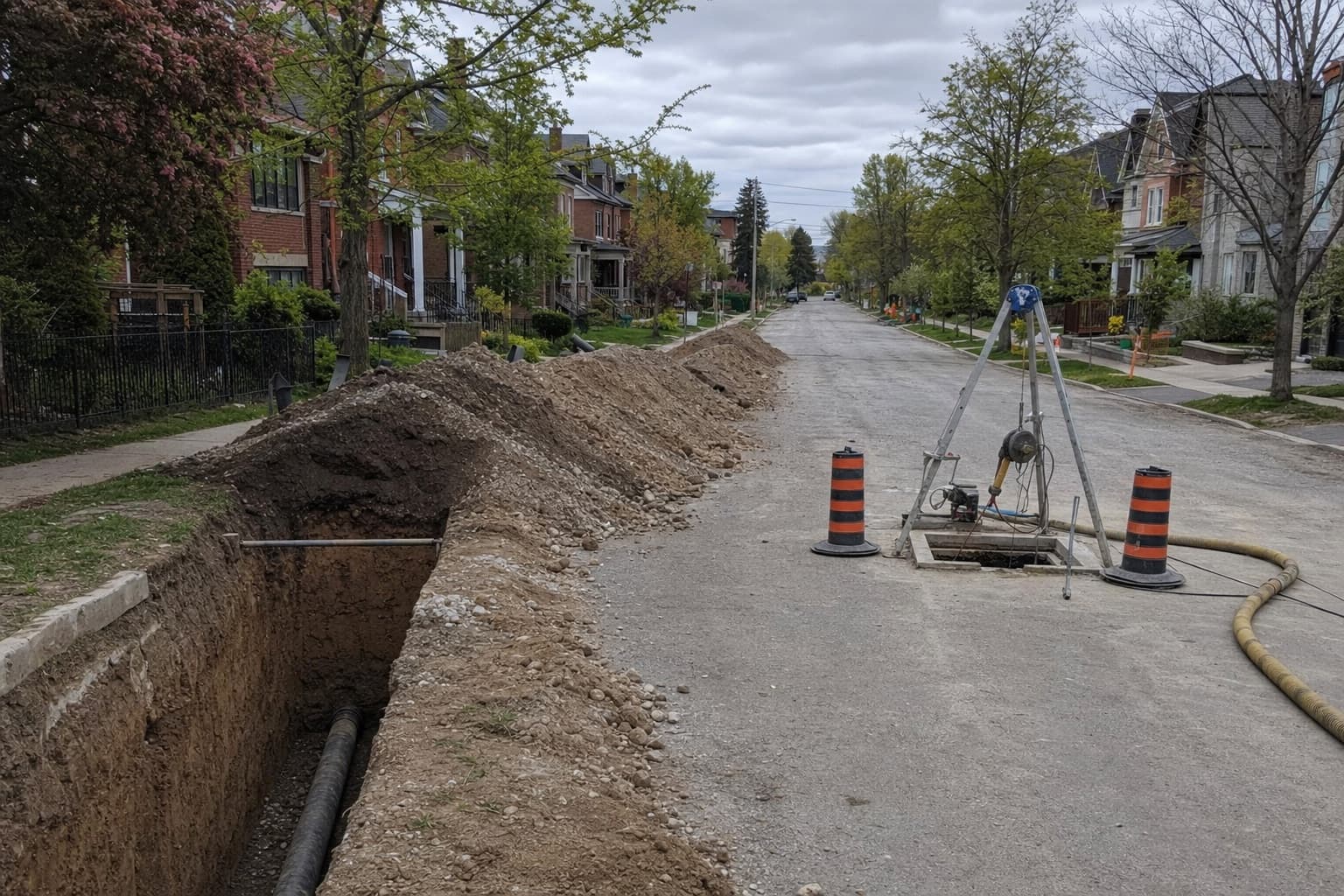
Bursting is trenchless in the sense that the length is not opened, not in the sense that nothing is dug. An entry pit and a receiving pit are excavated at each end of the run, and the machine needs somewhere to sit and something to pull against. On a residential lateral that usually means a pit at the house connection and another at the main. Where those pits land, and what is on the surface above them, is a real part of the job.
What the soil has to allow
The old pipe fragments have to go somewhere, and they go into the surrounding ground. Soil that can absorb that displacement is a candidate. Rock, and ground so tight that the displacement has nowhere to go, is not. Neither is a line running close alongside other buried services, because the same displacement that makes room for the new pipe can reach whatever is next to it. This is why a utility search sits beside the camera survey in the preparation rather than after the method has been chosen: the records say what is in the corridor, and the corridor is what the method acts on.
Which defects it answers and lining does not
A collapsed section has no bore to line through, and bursting does not need one to survive: the head is pulled through the corridor the old pipe occupied. Severe deformity, badly offset joints and a pipe that is simply too small for what the building now puts through it are the other cases where replacement in place beats rehabilitation. The defects that rule lining out are listed in the article on bellies.
What it does not fix
Grade. A pipe laid to a bad fall, a belly holding water, is replaced along the same corridor and therefore keeps the same fall. Bursting is a method for replacing a pipe where it lies, so any defect that is a property of where it lies survives it. That is an open-cut correction, and no trenchless method changes it. Nor does it solve a problem that was never in the pipe. A line that backs up because of what is put into it, or because the main it discharges to is surcharged, will back up through a new pipe exactly as it did through the old one. Replacing the pipe is expensive proof of that, and the survey is the cheap version.
What to have before anyone quotes it
A camera survey with distances and depths, the pipe material and diameter, what else is buried nearby, and what is on the surface at both ends where the pits will go. Without those, a bursting quotation is priced on assumptions, and the assumptions surface as change orders once the pits are open. The same discipline applies to every method, and the scope fields are on the scope page.
Find out which trenchless method your line can take
It is decided on the survey, not on the phone. Insist the camera recording with distances is yours.
CIPP Connect is an independent reference on buying pipe rehabilitation. It lines no pipe and holds no contractor licence. It explains what a survey has to show, which defects rule lining out, what a scope must specify, and what verification to demand on work you will never see with your own eyes.