October 2, 2026 · 6 min
Commercial sewer line repair: what changes when the building is a business
A restaurant, a clinic or an apartment block cannot simply stop using its drains for a week. Continuity, tenants, permits, night work, and the paperwork the landlord and the insurer will ask for.
Commercial sewer line repair is a question asked by a different person from the rest of this site: a facilities manager, a landlord, a restaurant operator, a property manager with a tenant on the phone. The pipe is often the same pipe. What changes is everything around it. A business cannot stop using its drains for a week, has people in the building who did not commission the work, answers to a landlord or an insurer, and needs paper at the end. This article is about those differences, and about what lining does and does not cover in a commercial building. The house version of the same pipe is covered in what is specific to a house lateral.
Continuity: the line has to keep working
A house can use the neighbours’ bathroom for an afternoon. A restaurant, a clinic, a hotel or an apartment block cannot, and that single fact reshapes the job. It means bypass pumping while a section is out of service, work staged so that one stack or one branch is down at a time, and a cure schedule planned around the hours the building can spare. It also means the survey has to happen without closing the business, which is entirely possible and needs saying at the booking stage. How lining work is planned around an occupied building is on the commercial lining page.
Tenants, occupants and who commissions the work
In a multi-tenant building the line that failed serves people who did not order the repair and may be paying for it through their lease. Notice has to go out, access has to be arranged, and the question of whose pipe it is, the tenant’s branch or the landlord’s stack, has to be answered from the drawings and the footage rather than from the lease alone. The survey log, with defects located by distance, is often the document that settles who pays, which is a reason to commission it before anyone starts arguing.
Permits and the jurisdiction
Work on a commercial drainage system would usually need a plumbing permit, and work that reaches the public right of way would usually need its own, but the requirements vary by state, by municipality and sometimes by the building’s occupancy type. A food service premises may have an inspector interested in the schedule. Ask who pulls the permit and who meets the inspector, and get the answer in writing, because in a commercial building the person who signs the permit is the person the inspector will hold to the work.
Night and weekend work
Most commercial lining and repair happens when the building is empty, which changes the job in three ways. The crew works to a window that closes at opening time, so the sequence is planned to the hour and the line has to be back in service, tested, before staff arrive. Noise, ventilation and access are managed for a building with nobody in it, and security wants to know who is where. And the cost reflects the hours, which is a reason to fix a recurring problem on a planned night rather than an unplanned one. The unplanned night is covered in emergency sewer line repair.
The paperwork the landlord and the insurer will ask for
A commercial repair is not finished when the pipe flows. It is finished when the file exists: the pre-work survey recording and log, the written scope with exclusions, on a lining job the liner thickness calculation and the cure record, the post-work camera pass showing the finished pipe, and the permit closure. The landlord wants it for the asset register. The insurer wants it to decide whether a future claim is a new event or a known condition. The next tenant’s lawyer wants it too. Ask for the file by name before the work starts. What a survey of a commercial building involves, and why its price differs from a house, is on what decides a survey cost.
The commercial defect profile
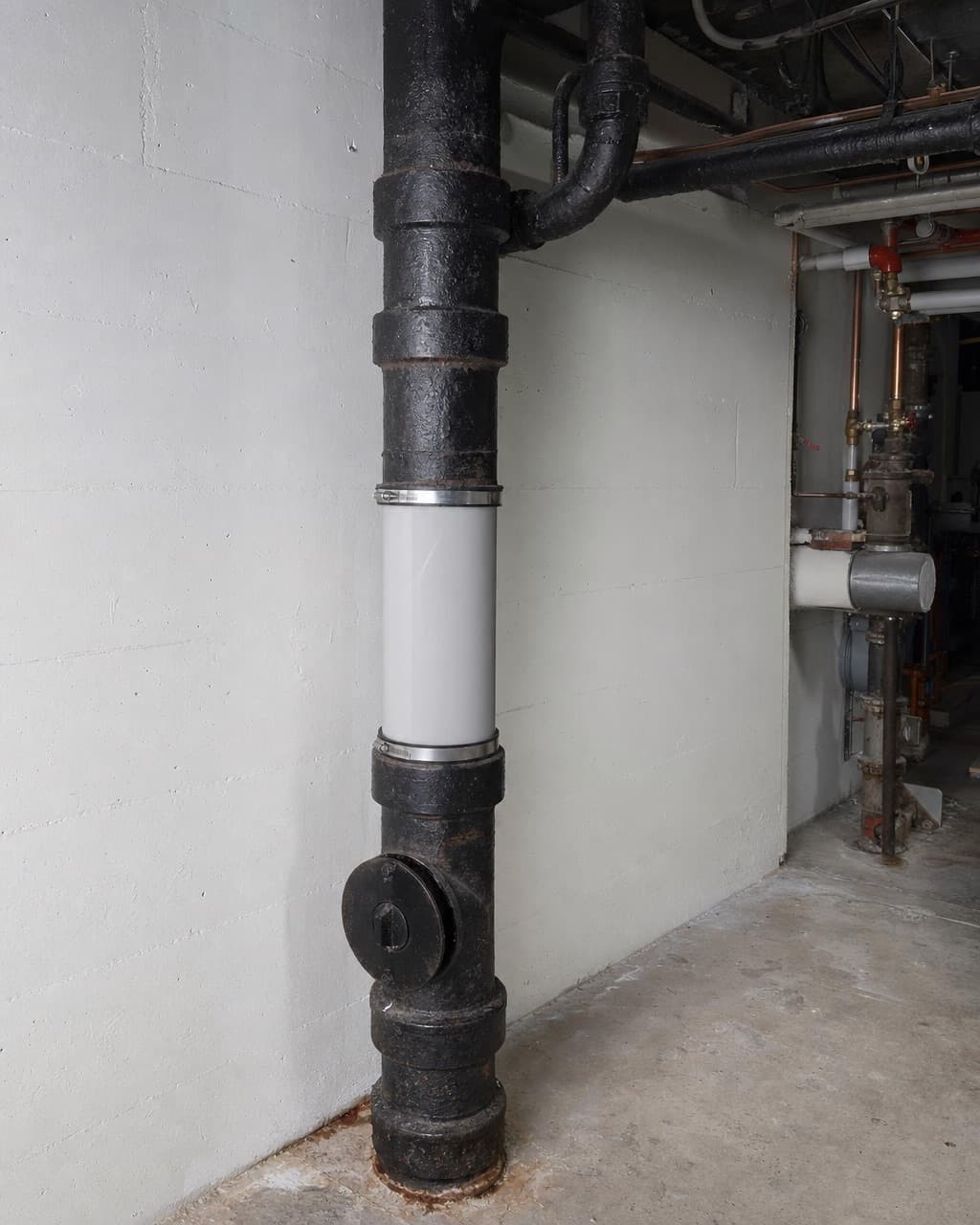
Commercial lines fail differently. Kitchens put grease into cast iron, which scales and narrows until a jetter is a maintenance contract. Long horizontal runs under slabs develop bellies where the fill settled. Older stacks corrode at the base. Much of this is lining territory, because the pipe usually still holds its shape and a liner restores a smooth bore under a floor nobody wants to cut. Some of it is not: a belly under a slab is still a belly, and saying so is the same rule that applies to a house. Process lines in a plant are a different case again, set out on industrial pipe rehabilitation.
What lining does not cover
Grease interceptor pumping and maintenance is a service contract, not a repair. Fixture drains inside a tenant space are the plumber’s. The municipal main is the utility’s. Choosing between the trades that do answer the call, and what to ask each, is on the contractors article. Our part starts at the survey and ends with the file, and it is planned around a building that stays open.
Plan it around a building that stays open
Tell us the hours the building can spare and who needs the file at the end. The survey and the scope come first, the night window second.
CIPP Connect is an independent reference on buying pipe rehabilitation. It lines no pipe and holds no contractor licence. It explains what a survey has to show, which defects rule lining out, what a scope must specify, and what verification to demand on work you will never see with your own eyes.